Reels tagged #history

KnowledgeReels
Swipe up
History

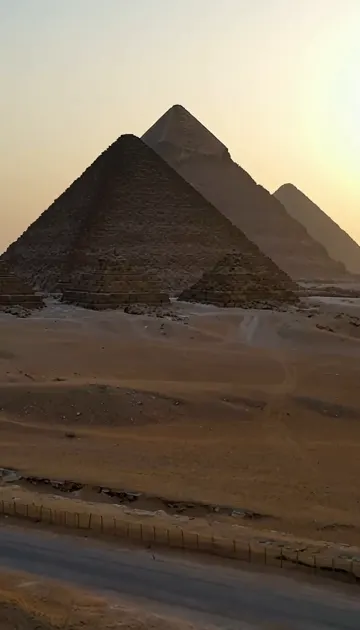
The Great Pyramid held a record for 3,800 years

At 146 metres, the Great Pyramid of Giza was the tallest structure humans built until Lincoln Cathedral overtook it in the 1300s.

History

Cleopatra lived closer to the Moon landing than to the pyramids

The Great Pyramid was already 2,500 years old in Cleopatra's lifetime. She lived only about 2,000 years before Apollo 11.

History

Oxford University is older than the Aztec Empire

Teaching began at Oxford around 1096. Tenochtitlan, capital of the Aztec Empire, was founded in 1325 — over two centuries later.

Chernobyl

The Chernobyl disaster began as a safety test

On 26 April 1986 engineers ran a late-night test to see if a dying turbine could power the cooling pumps. The test pushed Reactor 4 into an unstable state and it exploded within seconds.

Firsts

The first photograph took hours to shoot

Nicéphore Niépce made the oldest surviving photograph around 1826 in France. The pewter plate needed an exposure of many hours, so the sun lit both sides of the courtyard.

Firsts

The first phone call was a request for help

In March 1876 Alexander Graham Bell spoke the first words down a telephone to his assistant in the next room: "Mr. Watson, come here, I want to see you."

Firsts

The first powered flight lasted 12 seconds

On 17 December 1903 at Kitty Hawk, the Wright Flyer stayed airborne for 12 seconds and covered about 36 metres — shorter than the wingspan of a modern airliner.

Firsts

The first human in space orbited in 108 minutes

Yuri Gagarin launched on 12 April 1961 and circled the whole planet in 108 minutes. He ejected and parachuted down separately from his capsule.

Firsts

The first text message said "Merry Christmas"

On 3 December 1992 engineer Neil Papworth sent the first SMS from a computer to a phone on the Vodafone network. Phones could not send texts back yet.

History

Pompeii was buried in a single day

When Vesuvius erupted in AD 79 it threw a 30 km column of ash into the sky, then collapsed into scorching surges that buried the city under metres of pumice within about 18 hours.

Firsts

The first computer programmer worked in the 1840s

Ada Lovelace wrote an algorithm for Charles Babbage's unbuilt Analytical Engine in 1843, and predicted machines could one day compose music.

History

The famous Pompeii bodies are casts of empty space

The victims decayed, leaving hollow cavities in hardened ash. In 1863 archaeologists poured plaster into those voids, recreating the exact poses of people who died 1,800 years earlier.

History

Pompeii preserved Roman graffiti

Thousands of messages survive scratched into its walls — election slogans, love notes, insults and bar tabs. It is the closest thing we have to ordinary Roman voices.

Firsts

The first modern Olympics had no women

Athens 1896 gathered around 240 athletes from 14 nations, all of them men. Women first competed at the Paris games four years later.

Firsts

Europe's first printed book took years to print

Gutenberg's Bible, finished around 1455, used movable metal type. Roughly 180 copies were printed and about 49 still survive today.

Technology

Moore's law was an observation, not a law

In 1965 Gordon Moore noticed transistor counts doubling roughly every year, later revised to two. That guess became the industry's roadmap for half a century.

AI

The test for machine thinking is 75 years old

In 1950 Alan Turing proposed the imitation game: if a person cannot tell a machine from a human in conversation, asking whether it thinks may be the wrong question.

AI

The first neural network ran in 1958

Frank Rosenblatt's Perceptron was a physical machine with motor-driven weights that learned to classify simple shapes — decades before the deep learning boom.

AI

One 2017 paper reshaped modern AI

"Attention Is All You Need" introduced the Transformer, letting models weigh every word against every other word at once. Almost every large model today descends from it.

AI

A photo dataset kicked off the deep learning era

ImageNet gathered millions of labelled images, and in 2012 a deep network called AlexNet cut the error rate so sharply that the field changed direction overnight.

Inventions

Gutenberg's press made books 300 times faster

Before 1440 a scribe needed months to copy one book by hand. Gutenberg's movable-type press could print hundreds of pages a day, and Europe went from a few thousand books to millions within 50 years.

Inventions

The telephone patent was filed hours before a rival's

Alexander Graham Bell filed his telephone patent on 14 February 1876, only hours before Elisha Gray filed a caveat for a very similar device. Those few hours shaped the entire telecom industry.

Inventions

The wheel was invented for pottery, not transport

The oldest known wheels, from about 3500 BC in Mesopotamia, were potter's wheels. It took roughly another 300 years before anyone mounted one on an axle to move a cart.

Inventions

A submarine attacked a warship in 1776

The Turtle, a one-man wooden sub cranked by hand, tried to attach a bomb to a British ship in New York Harbour during the American Revolution.

Inventions

Canned food arrived 50 years before the can opener

Napoleon's prize for preserving army rations produced sealed tins in 1810. For decades soldiers opened them with a hammer and chisel or a bayonet.

Inventions

The sewing machine sparked a riot

In 1830 Barthelemy Thimonnier's Paris workshop was destroyed by tailors who feared his machines would take their jobs.

Inventions

Spectacles were invented around 1286 in Italy

Glass lenses were held together by a rivet and balanced on the nose. Ear arms did not appear for another 450 years.

Sports

Basketball was invented with two peach baskets

James Naismith nailed fruit baskets to a gym balcony in 1891 to keep students active indoors. Someone had to fetch the ball out after every score.

Sports

The Olympic torch relay is younger than you think

Ancient Greece had sacred fires, but the cross-country relay from Olympia was invented for the 1936 Berlin Games and kept ever since.

Sports

One cricket match lasted twelve days and still had no winner

The 1939 Timeless Test in Durban was played to a finish, until the England team had to leave to catch their ship home.

Sports

Boxing rounds are three minutes because of a pocket watch

The 1867 Queensberry rules fixed three-minute rounds with a minute's rest, a timing convenient for the stopwatches of the day, and it never changed.

Sports

Rugby is named after a school

The game took its name from Rugby School in England, where the handling code split away from football in the 1800s.

Sports

Wrestling may be the oldest sport on Earth

Cave paintings and Sumerian carvings show the same holds used today, some of them around 15,000 years old.

Sports

Basketball had no three-point line until 1979

The NBA adopted the arc as a gimmick to add excitement. It ended up rewriting how the entire sport is played.

Sports

Nearly every racehorse descends from three stallions

Thoroughbred pedigrees trace back to three Arabian and Barb stallions imported to England around 1700.

Sports

The Paralympics began in a hospital

A 1948 archery contest for spinal injury patients at Stoke Mandeville grew into a global Games held alongside the Olympics.

Sports

The ancient Olympics ran for nearly 1,200 years

From 776 BC until Roman emperors banned them around AD 393, the Games were held every four years without a break.

Sports

Volleyball was invented as a gentler alternative to basketball

William Morgan created it in 1895 for older gym members who found the new game too rough.

Sports

The English Channel was first swum in 1875

Matthew Webb took nearly 22 hours coated in porpoise grease. Thousands have followed, but most attempts still fail.

Sports

The javelin was redesigned because throws got too long

By 1984 javelins were landing near the far end of stadiums, so the centre of gravity was moved forward to shorten flights.

Sports

Tug of war used to be an Olympic sport

It was contested from 1900 to 1920, and one London police team won gold while still on duty rosters.

7 Wonders

A man burned a wonder just to be remembered

In 356 BC Herostratus set fire to the Temple of Artemis seeking fame. Ephesus banned anyone from speaking his name, yet historians recorded it anyway and the ban failed.

7 Wonders

Earthquakes toppled the Mausoleum over centuries

A series of quakes between the 12th and 15th centuries wrecked the tomb, and crusaders reused its polished stone to fortify Bodrum Castle, where the blocks are still visible.

7 Wonders

Romans may have flooded the Colosseum for sea battles

Ancient writers describe naumachiae, mock naval battles staged in the flooded arena before the underground hypogeum was built beneath the floor.

7 Wonders

The ancient list was a tourist guide

Greek writers compiled the seven wonders as sights worth seeing around the Mediterranean, all within reach of a traveller from the Hellenistic world. Places beyond it were never considered.

Countries

Thailand was never colonised by Europe

Skilled diplomacy between British and French empires kept Siam independent while neighbours fell. Its name means land of the free.