Reels tagged #mythology

KnowledgeReels
Swipe up
Mythology

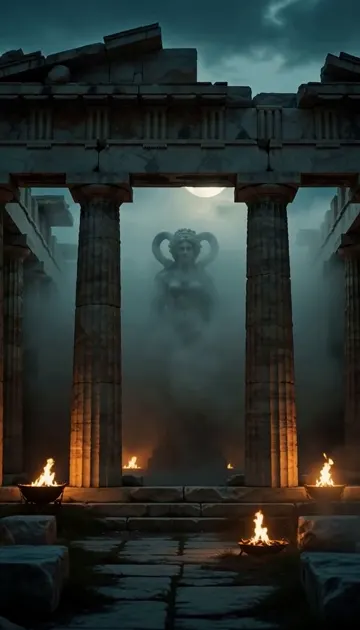
Medusa was cursed, not born a monster

In Ovid's telling, Medusa was a beautiful priestess of Athena. After Poseidon assaulted her in the goddess's temple, Athena punished Medusa instead of him, turning her hair into serpents and her gaze to stone.

Mythology

Icarus fell because he ignored both warnings

Daedalus told his son not to fly too high, where the sun would melt the wax of his wings, nor too low, where sea spray would soak the feathers. Icarus soared toward the sun and the wings came apart over the Aegean.

Mythology

Thor's hammer had a famously short handle

In Norse myth, Mjolnir was forged by dwarves while Loki, in the shape of a fly, stung the smith. The distraction left the handle too short, but the hammer still never missed and always returned to Thor's hand.

Mythology

Norse cosmology hangs from a single tree

Yggdrasil, the world ash, connects nine realms through its roots and branches. An eagle sits at its crown, a dragon gnaws at its roots, and a squirrel named Ratatoskr carries insults between them.

Mythology

Egyptians believed the heart was weighed against a feather

In the Hall of Two Truths, Anubis balanced the dead person's heart against the feather of Ma'at. A heart heavier with wrongdoing was devoured by Ammit, ending any hope of the afterlife.

Mythology

The sun god sailed through the underworld every night

Egyptians pictured Ra crossing the sky in a solar barque by day, then travelling the underworld river at night, fighting the serpent Apophis before being reborn at dawn.

Mythology

Gods and demons churned an ocean of milk

In the Samudra Manthan, devas and asuras used a mountain as a churning rod and a serpent as the rope to stir the cosmic ocean, releasing poison, treasures and finally the nectar of immortality.

Mythology

A myth says Hanuman tried to eat the sun

In the Ramayana tradition, the infant Hanuman mistook the rising sun for a ripe fruit and leapt into the sky to grab it, a story used to explain his extraordinary strength and flight.

Mythology

Norse myth predicted the end and the restart

Ragnarok destroys the gods, the sun and the earth in fire and flood. But the myth does not stop there: the world rises green again from the sea and two humans emerge from a wood to begin it all over.

Mythology

The feathered serpent gave humanity maize

Mesoamerican myth credits Quetzalcoatl with bringing maize to people, sometimes by turning into an ant to steal a single grain from inside a mountain, and with teaching farming and the calendar.

Mythology

The labyrinth was designed to be inescapable

Daedalus built the Cretan labyrinth so cunningly that he barely escaped it himself. Theseus survived only because Ariadne gave him a thread to unwind as he walked into the dark.

Mythology

Pandora's box was actually a jar

The Greek original describes a pithos, a large storage jar. A mistranslation in the 16th century turned it into a box. When it opened, every evil escaped and only hope was left inside.

Mythology

Sisyphus was punished for cheating death twice

He tricked Thanatos into chains so no one could die, then talked his way out of the underworld. Zeus sentenced him to roll a boulder uphill forever, watching it roll back each time.

Mythology

The phoenix myth travelled across three cultures

Egyptian, Greek and Roman writers all describe a bird that burns and is reborn from its ashes, usually on a cycle of about 500 years, making it one of the ancient world's most widely shared symbols.

Mythology

Valkyries chose who died in battle

In Norse belief, valkyries were not just warrior maidens but selectors of the slain. They carried chosen fighters to Valhalla, where they feasted and trained for the final battle at Ragnarok.

Mythology

A spider owns all the stories in West African myth

Anansi bought the world's stories from the sky god Nyame by capturing a python, a leopard and a swarm of hornets. Since then, folktales across West Africa and the Caribbean are called Anansesem.

Mythology

Chinese dragons control water, not fire

Unlike European fire-breathing dragons, the Chinese long is a benevolent water spirit ruling rivers, rain and the sea. Emperors claimed descent from dragons and farmers prayed to them for rain.

Mythology

Japan's sun goddess once hid in a cave

Insulted by her brother, Amaterasu shut herself in a cave and the world went dark. The other gods lured her out with a dance and a mirror showing her own radiance, returning light to the world.

Mythology

The oldest surviving epic is 4,000 years old

The Epic of Gilgamesh, written on clay tablets in Mesopotamia, tells of a king searching for immortality. It includes a great flood story recorded centuries before the biblical version.

Mythology

Cerberus guarded the exit, not the entrance

The three-headed hound of Hades let the dead walk in freely. His job was to make sure none of them ever walked back out, which is why Orpheus had to charm him with music.

Mythology

Baba Yaga's hut stands on chicken legs

In Slavic folklore, the witch lives in a hut that walks on giant fowl legs and turns to face visitors. She flies in a mortar, steering with a pestle, and may help or eat whoever finds her.

Mythology

Atlas holds up the sky, not the earth

Greek myth punishes Atlas by making him carry the celestial sphere on his shoulders. Renaissance artists drew him holding a globe, and books of maps have been called atlases ever since.

Mythology

The Rainbow Serpent carved Australia's rivers

In many Aboriginal traditions, the Rainbow Serpent moved across the land during the Dreaming, its body gouging out riverbeds and waterholes and bringing the wet season rains.

Mythology

Orpheus lost Eurydice with one glance

His music persuaded Hades to release his wife on one condition: he must not look back until both reached the surface. Steps from daylight he turned, and she was pulled back forever.

Mythology

Loki once became a horse and gave birth

To sabotage a builder's bargain, Loki transformed into a mare to lure away the giant's stallion. He later returned with Sleipnir, the eight-legged horse that became Odin's mount.

Mythology

The golem was animated by a written word

In Jewish legend, a rabbi of Prague shaped a man from river clay and brought him to life with a holy name. Erasing one letter from the word emet, truth, left met, death, and the golem crumbled.

Mythology

The kraken legend may come from real squid

Norwegian sailors described an island-sized beast that dragged ships under. Modern biologists point to the giant squid, which can exceed 12 metres and was only filmed alive in 2004.

Mythology

Mount Olympus is a real mountain you can climb

The home of the Greek gods is a genuine 2,917-metre massif in northern Greece. Its summit, Mytikas, was first recorded as climbed in 1913 and now draws thousands of hikers a year.

Mythology

Troy turned out to be a real city

For centuries the Trojan War was considered pure legend, until excavations in the 1870s in northwest Turkey uncovered a layered city at Hisarlik matching Homer's descriptions.

Mythology

A wolf was bound with impossible things

The gods could not hold Fenrir with iron, so dwarves wove the ribbon Gleipnir from the sound of a cat's footfall, a woman's beard, a mountain's roots, a bear's sinews, a fish's breath and a bird's spit.

Indian Mythology

Hanuman tried to eat the Sun

As an infant, Hanuman mistook the rising sun for a ripe mango and leapt into the sky to swallow it. Indra struck him down with a thunderbolt, injuring his jaw — the name Hanuman means "disfigured jaw".

Indian Mythology

Ganesha wrote with his own tusk

When Vyasa dictated the Mahabharata, Ganesha agreed to scribe it only if the telling never paused. Mid-epic his pen broke, so he snapped off his own tusk and kept writing.

Indian Mythology

Gods and demons churned an ocean together

In the Samudra Manthan, devas and asuras used Mount Mandara as a churning rod and the serpent Vasuki as the rope to pull nectar of immortality from the ocean of milk. Poison surfaced first — Shiva drank it.

Indian Mythology

Arjuna saw only the eye of the fish

Asked what he could see, every prince described the tree, the sky, the crowd. Arjuna said he saw nothing but the eye of the revolving fish — and that focus won him Draupadi's hand.

Indian Mythology

Karna was born wearing armour

Karna came into the world with kavach and kundal — divine armour and earrings fused to his body that made him invincible. Indra begged them away as charity, and Karna cut them off rather than refuse a request.

Indian Mythology

Bhishma chose the hour of his own death

Granted the boon of dying only when he willed it, Bhishma lay on a bed of arrows for 58 days after falling in battle, waiting for the sun to turn north before letting go.

Indian Mythology

Ravana was a scholar, not just a villain

The ten-headed king of Lanka was a master of the Vedas, an astrologer and a virtuoso of the veena. His ten heads are often read as the six shastras and four Vedas he had mastered.

Indian Mythology

Garuda stole immortality and gave it up

To free his enslaved mother, Garuda flew to the heavens and seized the pot of amrita from the gods — then handed it back without drinking a drop, earning Vishnu's friendship instead.

Indian Mythology

Shiva's dance destroys and creates

As Nataraja, Shiva dances the Tandava inside a ring of fire: the drum in one hand beats out creation, the flame in another consumes the universe, and his raised foot promises release.

Indian Mythology

The Ganga fell into Shiva's hair

The river's descent from heaven would have shattered the earth, so Shiva caught her in his matted locks and released her gently — which is why the Ganga is said to flow from his head.

Indian Mythology

Krishna held up a mountain for seven days

When Indra flooded Vrindavan in rage, the young Krishna lifted Govardhan hill on his little finger and sheltered the entire village and its cattle beneath it until the storm broke.

Indian Mythology

Narasimha was a loophole in a boon

Hiranyakashipu could not be killed by man or beast, indoors or out, by day or night. So Vishnu came as a lion-man, at dusk, on a threshold, and laid him across his lap.

Indian Mythology

Draupadi's sari never ended

Dragged into the Kuru court to be disrobed, Draupadi called on Krishna — and the fabric renewed itself endlessly until Dushasana collapsed from exhaustion. Her vow that day set the war in motion.

Indian Mythology

Eklavya taught himself with a clay teacher

Refused as a student, the tribal boy built a statue of Drona and practised before it until he outshot the princes. Drona then asked for his right thumb as fee — and Eklavya cut it off.

Indian Mythology

Kumbhakarna slept six months at a time

Meaning to ask Brahma for indrasana, a throne, the giant's tongue slipped and he asked for nidrasana — sleep. Waking him took drums, elephants and armies walking over his body.

Indian Mythology

A vulture fought Ravana alone

Jatayu, the ageing bird-king, attacked Ravana's flying chariot to stop Sita's abduction. His wings were cut away, but he lived long enough to tell Rama which way south the demon had flown.

Indian Mythology

Abhimanyu learned war in the womb

He overheard Krishna explain how to break into the chakravyuha while still unborn — but his mother fell asleep before the escape was described, and at sixteen he died inside the formation.

Indian Mythology

Parashurama made the sea retreat

The axe-wielding sage is said to have flung his weapon into the Arabian Sea, and the waters drew back to create the coastal strip of Konkan and Kerala — land raised from the ocean floor.

Indian Mythology

One avatar has not arrived yet

Kalki, the tenth avatar of Vishnu, is prophesied to appear at the end of Kali Yuga on a white horse with a blazing sword, ending the age and turning the wheel of time back to gold.

Indian Mythology

Sita was found in a furrow

King Janaka ploughed a field for a ritual and turned up an infant in the soil. Her name means "furrow", and at the end of the Ramayana she asks the earth to take her back — and it does.